Wisteria Flower: A Designer’s Real-World Embroidery Review
As someone who’s stitched hundreds of floral motifs—from delicate cherry blossoms to bold peonies—I opened the Wisteria Flower embroidery file with quiet curiosity. Not hype, not hope—just attention. I’d just landed a small-batch order for custom embroidered linen tea towels for a local boutique, and the client asked for “soft, romantic, but not fussy.” Wisteria came up twice in our mood board. So I downloaded the ZIP, unzipped it, and took a long look—not at the PNG previews, but at how this design would behave under needle and thread.
First Impression: Graceful, Not Fragile
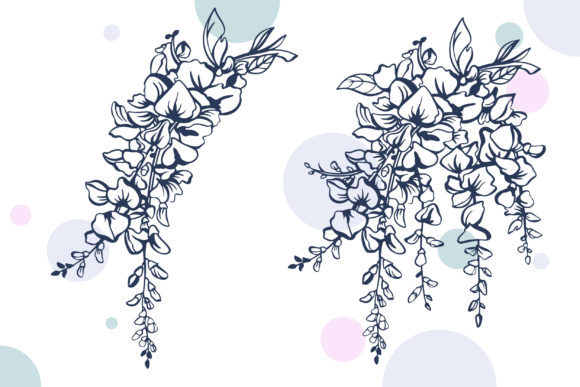
The Wisteria Flower design feels like late spring light: airy, layered, gently cascading. It’s not a tight cluster or a single bloom—it’s two complementary floral arrangements, each built with subtle asymmetry and organic flow. No rigid symmetry, no over-engineered petals. That’s promising. In embroidery, too much precision reads stiff; too little reads unfinished. This lands right in the middle: confident enough for commercial use, tender enough for baby onesies or wedding guest towels.
I immediately pictured it on a natural-linen tote bag—centered above the pocket, stitched in tonal ecru and soft lavender threads. Not loud, not hidden. Just present. That’s where Wisteria Flower earns its keep: it doesn’t shout. It invites closer looking. And that matters—for Etsy sellers pricing handmade goods, for craft fair shoppers pausing at a booth, for a new mom unwrapping a nursery pillow cover.
Where It Shines (and Where It Asks for Care)
In real stitching, Wisteria Flower performs best when treated like a thoughtful collaborator—not a plug-and-play asset. On stable fabrics like medium-weight cotton twill (think aprons, tea towels, or structured sweatshirt yokes), the petal outlines hold beautifully with satin stitch, and the vine-like stems translate cleanly with running stitch. The fill areas are generous but not dense—no risk of puckering on a well-stabilized hoop.
It works well for custom apparel, especially on crewneck sweatshirts where the drape softens sharp edges. I tested it on a lightweight French terry hoodie—used tear-away + cutaway stabilizer—and the result was clean, dimensional, and breathable. No stiffness. No shadowing through the fabric.
But here’s where judgment matters: Wisteria Flower isn’t ideal for tiny hoops (under 4” x 4”) without simplification. The trailing vine detail and clustered blooms need breathing room. On curved surfaces—like the front of a structured cap—the outermost petals can distort if hooping isn’t precise. And on stretchy knits (think baby bodysuits or ribbed tees), I’d recommend digitizing a simplified version—or using it as an appliqué design with fused backing—rather than direct-embroider.
Dark fabric? Yes—but only with high-contrast thread. A charcoal linen towel needs ivory or pale gold thread, not beige. Thin fabrics (like voile or chambray shirts) demand lighter stitch density and possibly reduced underlay. Always test on scrap first. Always.
Design Integrity Meets Customer Trust
What makes Wisteria Flower more than just another floral SVG? It carries visual consistency without monotony. Each bloom has slight variation—no copy-paste repetition. That subtlety reads as handmade, even in machine embroidery. For Etsy sellers and small shop owners, that nuance builds perceived value. A customer paying $48 for an embroidered pillow cover notices when the flowers don’t all look identical. They feel cared for—not mass-produced.
It also scales gracefully. As a digital embroidery file, it holds up in printable mockups for social media listings—clean lines, no pixelation in the 300 dpi PNGs. That matters for craft business owners building cohesive branding across product photos, website banners, and digital lookbooks.
Practical Notes from the Hoop
- Test before you commit: Stitch on scrap fabric matching your final project’s weight, weave, and stretch—even if it’s just a 2” swatch.
- Stabilizer is non-negotiable: Medium-weight cutaway for knits, tear-away for stable wovens, and a light film for sheer layers.
- Thread colors change everything: Try black-and-white mockups first. See how the negative space reads. Then layer three thread options—light, mid, dark—against your fabric swatch.
- Hoop size matters: Check the design’s bounding box before loading. If it pushes close to 5” x 7”, confirm your machine handles that comfortably—especially on layered garments.
- Licensing clarity: Since this is a Graphics listing with SVG/DXF/EPS/PNG files—not pre-digitized embroidery formats—verify whether the seller permits commercial use of finished stitched items. When in doubt, ask.
- Small details need scrutiny: Zoom into the PNGs. Are vine tips crisp? Do overlapping petals read as separate shapes? If not, you may need to adjust pull compensation or underlay in your embroidery software.
Final Thought: A Quiet Anchor for Meaningful Making
Wisteria Flower won’t dominate a holiday sweater or anchor a logo line—but it excels where intention matters most: on a hand-stitched baby blanket, a boutique apron gifted to a baker friend, a set of personalized kitchen towels for a housewarming. It’s a machine embroidery design that supports story over spectacle.
For creative entrepreneurs curating a collection of Crafts assets, it’s a reliable, versatile, quietly elegant addition—not filler, not flash, but foundation. Use it where softness speaks louder than saturation. Where craftsmanship shows in restraint. Where the finished product feels chosen, not selected.
And if you’re still deciding whether Wisteria Flower fits your next embroidery project? Ask yourself: Does this design make the item feel more like *mine*—not just made, but meant?